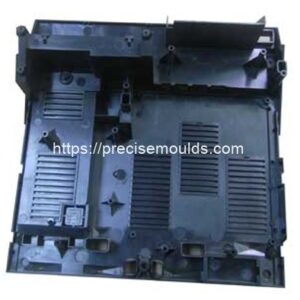
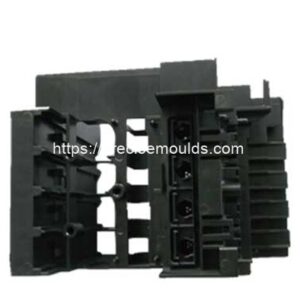
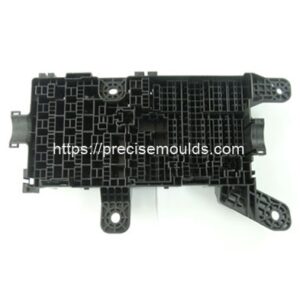
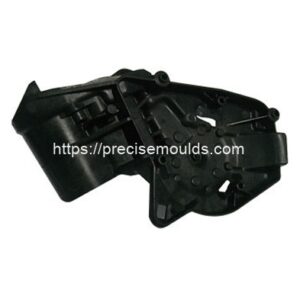
GF filled nylon interior automotive part

Product description: GF filled nylon interior automotive part
| Part material: | 30% GF filled PA66 |
|---|---|
| Mold manufacturer: | China |
| Cavity/core steel: | AISI H13 |
| Runner system: | Cold runner |
| Cavity No: | 2 cavities |
| Customer type: | Auto injection molding company |
| Processing: | Plastic molding |
| Mold standard: | HASCO |
GF filled nylon interior automotive parts are essential components in modern vehicles, valued for their strength, durability, and lightweight characteristics. The automotive aftermarket has seen a rising demand for these GF filled nylon interior automotive parts, as they are often used to replace original equipment due to their superior properties. The manufacturing process of GF filled nylon parts is intricate, requiring precision in plastic molding to ensure that the final product meets the stringent quality standards expected in the automotive industry.
One of the primary advantages of GF filled nylon is its excellent resistance to warpage during the molding process. This characteristic is crucial, as any warpage can affect the part’s fit and compatibility with other vehicle components. Manufacturers use advanced techniques, such as controlled cooling and optimized mold designs, to mitigate the risk of warping. The ability to produce parts with high dimensional accuracy is a significant benefit, especially for interior components that must align perfectly with the vehicle’s design.
Additionally, the use of GF filled nylon interior automotive parts plays a critical role in enhancing the overall performance of vehicles, making them a popular choice among manufacturers.
How do you prevent warpage and shrinkage in GF-filled nylon interior components?
Glass-fiber reinforcement causes anisotropic shrinkage (differential shrinkage parallel vs. perpendicular to fiber orientation), which is the primary driver of warpage in large automotive structural panels:
DFM & Fiber Orientation Simulation: Using Moldflow software during mold design to predict fiber alignment, weld line positions, and volumetric shrinkage.
Balanced Wall Thickness & Transition Radii: Maintaining uniform nominal wall thickness ($2.5\text{ mm}$–$3.5\text{ mm}$) and adding generous radii at rib-to-wall intersections to minimize localized stress concentration.
Strategic Gate Placement: Placing gates so the melt flows along the primary load path and long dimensions, minimizing transverse differential shrinkage. Sequential valve gating (SVG) is often required for large structural trims.
Uniform Mold Temperature Control: Using high, tightly controlled mold temperatures ($80^\circ\text{C}$–$110^\circ\text{C}$) to ensure symmetrical cooling on both core and cavity sides.
Employing GF filled nylon interior automotive parts not only improves the structural integrity of the vehicle but also contributes to weight reduction, which is increasingly important in automotive design.
What critical processing parameters are required for injection molding GF nylon?
Polyamide resins are hygroscopic and heat-sensitive, requiring precise injection parameter management:
Thorough Resin Drying: Nylon must be dried using a dehumidifying desiccant dryer to a moisture content below 0.1% (ideally $<0.05\%$) before molding. Moisture causes hydrolytic degradation, splay marks, and loss of mechanical properties.
High Mold Temperatures ($80^\circ\text{C}$ to $110^\circ\text{C}$): Promotes proper polymer crystallization and surface aesthetic quality while reducing internal molded-in stress.
Optimized Screw Speed & Back Pressure: Using low screw RPM and moderate back pressure to prevent mechanical shear damage to the glass fibers, preserving fiber length for maximum strength.
Multi-Stage Injection Speed: Utilizing fast injection speed through the gates to prevent fiber orientation freezes, followed by controlled packing pressure to eliminate sink marks.
Incorporating advanced techniques in the manufacturing of GF filled nylon interior automotive parts leads to enhanced product performance, giving vehicles a competitive edge in the market.
How do you eliminate floating fibers and poor surface finish on Class-B interior parts?
Because glass fibers tend to migrate to the surface as resin cools against cold mold walls, “floating fiber” (silver streaks or rough texture) can occur on visible interior surfaces:
Higher Mold Surface Temperature: Utilizing Rapid Heat Cycle Molding (RHCM / Variotherm) or localized core heating keeps the cavity surface hot during injection, allowing a smooth resin skin to encapsulate the fibers.
Higher Injection Speed: Pushes the polymer melt quickly across the mold surface, preventing fibers from freezing ahead of the resin front.
Chemical / Laser Texturing: Applying low-gloss automotive textures (such as VDI 3400 or custom leather graining) on mold steel hides subtle fiber patterns on semi-visible interior trims.
Lastly, the versatility of GF filled nylon interior automotive parts allows them to be used in various applications, which is a significant advantage for automotive manufacturers.