 Insert molding
 Overmolding
 Unscrewing molds
 Automotive
 Electronics
 Home appliance
 Industrial equipment
 Medical devices
 Machinery & automation
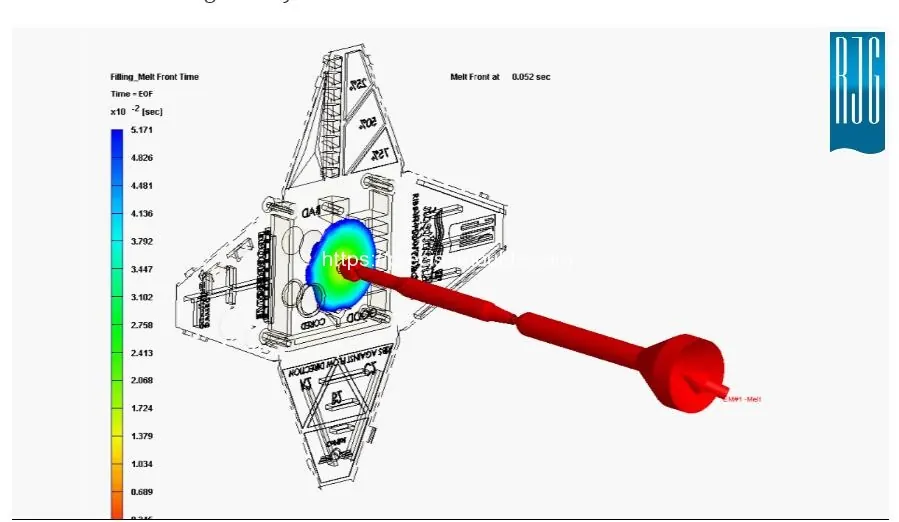
Every engineer wants to see how a part will mold before steel is cut. Once machining starts, changes cost time and money, so a good simulation can save weeks. But a simulation is only a model. Whether its prediction matches the part that comes out of the mold depends on a handful of inputs. In our experience as a mold maker, these seven decide the accuracy.
1. Mesh
The software divides the part into small elements and solves the flow in each one. A coarse mesh is fast but misses thin ribs, sharp transitions and local thickness changes. A finer mesh, especially through the thickness of the wall, gives better results for warpage and sink. We refine the mesh where the part is thin, ribbed or critical, rather than everywhere.
2. Solver and analysis type
Midplane, dual-domain and 3D solvers each make different assumptions. Thin, flat housings simulate well with simpler models; thick, chunky or highly 3D parts need a full 3D analysis. Choosing the wrong type is a common reason for disappointing results.
3. Material data
The prediction is only as good as the resin data behind it: viscosity, pvT behaviour, thermal properties and, for glass-filled grades, fibre orientation behaviour. Generic data for "PA66 GF30" can differ noticeably from the exact grade you buy. When accuracy matters, we use supplier-characterised data for the specific grade.
4. Mold design
Runner sizes, gate geometry, cooling channels and venting all change the result. A simulation that ignores the cooling layout will not predict warpage well. We model the runner and cooling as designed, not as idealised placeholders.
5. Molding machine
Real presses have limits on injection speed, pressure response and screw control. A simulation that assumes an ideal machine may predict a fill that a real press cannot deliver.
6. Process settings
Melt temperature, mold temperature, injection profile and pack pressure in the simulation must match what will be used at the trial. We record the simulated settings and use them as the starting point at T1, so the comparison is fair.
7. The user
Experience in setting up the model and reading the results matters as much as the software. Knowing which results to trust, and which to treat as trends, comes from comparing many simulations with real parts.
What simulation is good at
- Finding short shots, hesitation and air traps.
- Locating weld lines and meld lines.
- Comparing gate positions and runner layouts.
- Showing warpage trends and the effect of cooling changes.
Where we stay cautious
Absolute warpage values for glass-filled resins and exact cycle times are less reliable than trends. We use them to choose between options, and confirm the final numbers at the T1 trial.
At Nodinson, Moldflow is part of our engineering service for parts where filling, warpage or cooling is a risk. It is one of the reasons up to 90% of our molds pass at the first trial.
Our engineers review drawings and reply in English.