 Insert molding
 Overmolding
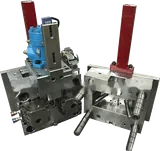 Unscrewing molds
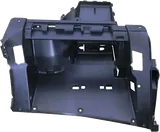 Automotive
 Electronics
 Home appliance
 Industrial equipment
 Medical devices
 Machinery & automation
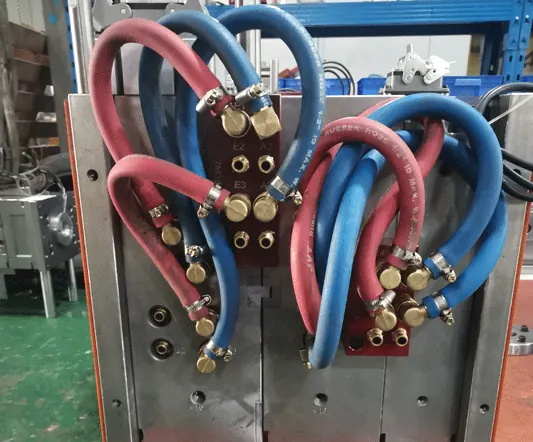
A common way to shorten a cycle is to turn the mold water colder. The assumption is simple: colder coolant, colder steel, faster cooling. In practice the gains often stop well before the chiller reaches its limit, and sometimes the parts get worse. Here is why.
Heat has to travel through the steel
Heat flows from the plastic into the cavity steel, through the steel to the cooling channel wall, and from the wall into the water. The slowest step usually controls the result. If the channels are far from the cavity surface, or the steel has low conductivity, colder water changes little at the part surface.
Flow rate matters as much as temperature
Water must flow turbulently to pick up heat well. A channel with low flow, or one shared by too many circuits, carries less heat away no matter how cold the water is. Checking the flow in every circuit is often a bigger win than lowering the temperature.
Condensation and surface defects
Below the dew point, moisture condenses on cold mold surfaces. Water on the cavity causes splay, streaks and corrosion. Very cold molds can also freeze the skin of the part too early, giving poor surface finish, flow lines or high moulded-in stress.
What actually shortens cooling time
- Cooling channels close and evenly spaced relative to the cavity surface.
- Baffles, bubblers or conformal cooling in deep cores and long ribs.
- High-conductivity inserts, such as beryllium-free copper alloys, in hot spots.
- Uniform wall thickness in the part design, since cooling time rises with the square of wall thickness.
- Correct flow rate and separate circuits for cavity and core.
How we design cooling
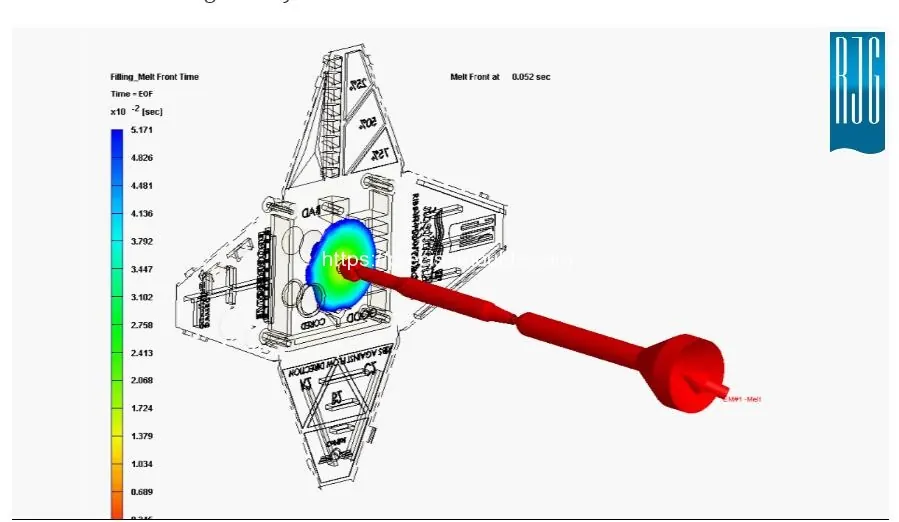
We design cooling with the mold, not after it. For deep cores and large parts we use Moldflow cooling analysis, and every mold's cooling circuits are pressure-tested before shipment as part of our quality control.
Our engineers review drawings and reply in English.